
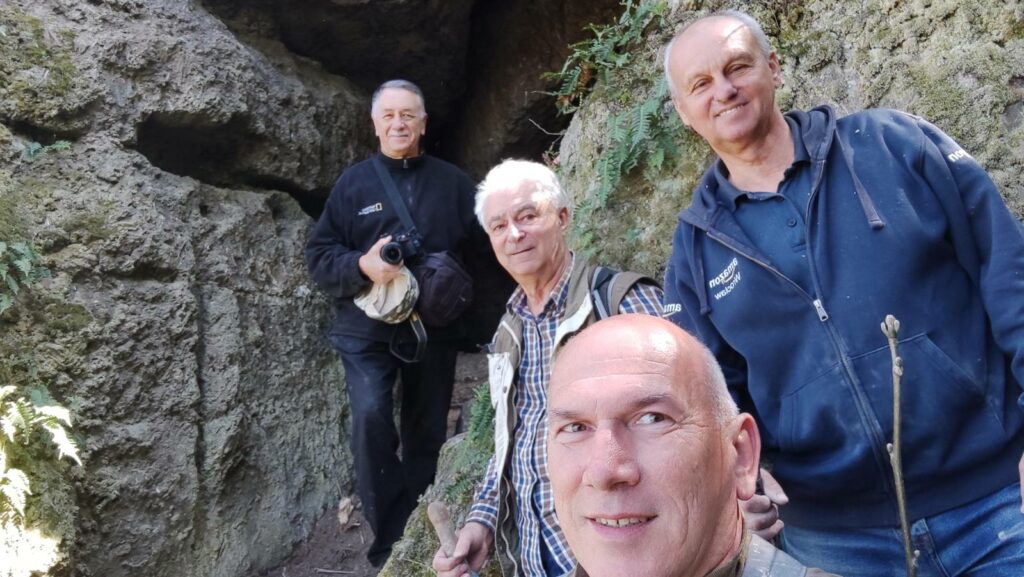
Scientists from the Institute of History, Ethnology and Archaeology of the Carpathians of the Vasyl Stefanyk Carpathian National University, consisting of associate professors Borys Khruslov and Mykhailo Moskalyuk, specialist Roman Kobylnyk, under the leadership of Professor Mykola Kugutyak, conducted scientific field research of the rock-cave defensive monastery in the village of Olievo-Korolivka in the Horodenkiv region for the first time on April 22 and 29, 2025.
The cave monastery near the village of Olievo-Korolivka was first mentioned in passing in the publication of the researcher of cave monuments of the late 19th century A. Hrushetsky. Similar mentions are limited to publications of the late 20th – early 21st centuries.
The Carpathian Historical and Archaeological Expedition of the Institute of History, Ethnology and Archaeology of the Carpathians of the Vasyl Stefanyk Carpathian National University has begun studying a rocky karst massif located in the southern part of the village, which extends along the northeast-southwest line with a length of about 400 m and a height of up to 40 m. It is located at the junction of the villages of Oliyevo and Korolivka, 100 m from the southern corner of Korolivka, called Pidpechery, and is considered the oldest in the village, behind the Lozanivka River, which flows into the Dniester. According to local legends, people hid from the Tatars in the caves of the rocky ridge in ancient times, and during the Second World War and after its end, UPA members had their hideouts there. There are no legends about the monastic tradition in the village.
The discovered entrance to the cave from the northeast is located at a height of 14 m. Five stone steps lead to it. The width of the entrance to the cave is 1 m, the height is 1.5 m. At the entrance, vertical cuts were discovered on both sides to block access to the cave. With their help, wooden structures of the side walls in the form of doors were attached. The study of the lower part of the vertical cuts indicates that the level of the cave floor was originally much lower than today.
From the entrance and inside, the cave is artificially expanded, as evidenced by the undercutting of the walls. It has an L-shaped appearance, typical of a number of medieval cave monasteries. The room of a subrectangular shape reaches 5 m in length, 1.6 m in width and 1.6–1.7 m in height in the western direction. The lateral branch of the cave at a right angle is 2 m. Due to the significant silting of the cave; the current level of its floor does not correspond to its original appearance. Part of the ceiling has broken off and hangs over the central part of the cave.
In the upper part of the left wall, an oblong niche 2.5 m long and 0.4 m high is carved, in the central part of which a polished slab with a graphic image of a cross and figures of two people in front of it, apparently monks, was discovered. Similar rock images were discovered in the hermit caves of Isakiv, Odaiv, and Petriv.
At the end of the left, eastern wall, a cross with expanded arm extremities is carved. Crosses of a similar configuration were applied to the monuments of ancient Halych, its dimensions are 0.3×0.4 m. At one time, it could have been painted with red paint. To the left of the cross, a polished slab in the form of an icon was discovered, on which an image resembling the evangelical scene of the Annunciation was applied. The dimensions of the image are 0.3×0.3 m. This central part of the cave was obviously used for ritual purposes and served as a kind of altar, a chapel for worship. Opposite, on the right wall of the cave, a niche about 0.4 m long and 0.20 m deep was carved out, which was obviously used in liturgical practice. Going down 7 m from the level of the cave, defensive fortifications were recorded in the form of two rock ledges, located at a distance of 6 m from each other on both sides. In the sidewalls of the rock ledges, large vertical cuts about 3 m high, more than 0.2 m wide were discovered. Wooden structures, which were attached to the niches of the sidewalls, blocked the entrance to the cave. Another defensive fortification was located at a level of 9 m from the cave in the form of a tower measuring 2.5×2.5 m. From the tower, the space near the rocks was covered by a rampart 9 m long and 0.5–0.7 m high.
20 m from the rocks with defensive fortifications in the northeast direction, another cave with a narrow passage was discovered, which further expands and goes deep into the rock.
Considering the cult nature of the monument, its interior, the features of the layout and technical means of forging, as well as the method of building a wooden defensive fortification using a rampart, tower and escarped slopes, it becomes obvious that the monument in Olievo-Korolivka belongs to the cave hermit complexes of the 12th–14th centuries, is a unique spiritual shrine that played an important role in the religious life of the region.